Leak tracing & repair
Basement Leak Repair, Matched to Where the Water Gets In
A basement leaking at the wall-floor seam needs a different repair than one leaking under a window, and a wall that turns out to be sweating needs no waterproofing at all. So start with where you see the water. Eau Claire Drainage & Waterproofing traces the entry point, names what is feeding it, and fixes that, from one injected tie hole to a full perimeter of drain tile.
- Licensed & Insured
- Free Inspections
- Locally Owned
- Year-Round Service
Diagnose your leak
Where Is Your Basement Leaking?
Water leaves evidence. Where it shows up, what it leaves behind, and when it appears narrow the cause to one or two candidates before anyone drills or digs. The table below is the same reading we do on an inspection, roughly in the order we check things, and the last column points to where each repair is covered in depth.
| Where you see water | Likely cause | Typical fix | Where it is covered |
|---|---|---|---|
| A wet line along the base of the wall, on one wall or all of them | Saturated soil pushing water through the cove joint | Interior drain tile and a sump; fix the surface water first if that is the feed | Basement waterproofing |
| One wet corner, a few hours after a hard rain | A downspout emptying at the wall, or soil sloping back toward the house | Extend the downspout, rebuild the grade | Yard drainage |
| Round wet spots or rust streaks at a regular spacing on a poured wall | Leaking form tie holes | Inject or plug each hole from inside | Tie holes, below |
| A damp line running up or across a poured wall | A leaking crack | Polyurethane injection; horizontal cracks get measured first | Foundation crack repair |
| Damp lower courses and white, chalky residue on a block wall | Water filling the hollow cores and weeping through the joints | Weep holes into interior drain tile, membrane on the wall face | Basement waterproofing |
| Water running down the wall below a window | A window well filling up and leaking at the frame | Clear the gravel, cover the well, regrade, drain the well bottom | Window wells, below |
| A wet ring around a pipe or conduit through the wall | A failed seal at the penetration | Inject the penetration from inside | Penetrations, below |
| Water rising through a floor crack | Water under the slab with nowhere to go | Drain tile at the slab edge into a sump | Sump pump installation |
| The whole wall or cold pipes beading on a humid day | Condensation, not a leak | A dehumidifier; confirm with the foil test | Foil test, below |
| A puddle in the same spot in dry weather | Plumbing: water heater, washer hose, supply line | A plumber, not waterproofing | Plumbing leaks, below |
A starting point, not a verdict. Two sources at once is common, and the inspection confirms which one is actually feeding the water.
The wall-floor seam
Wet Basement Repair Starts at the Cove Joint
The cove joint is the seam where the basement wall meets the floor. The wall sits on the footing and the slab was poured against it later, so it is a joint between separate pours, not one piece of concrete, and it is the first place pressurized water finds. The block wall pictured shows the pattern: a dark wet line along the base, white efflorescence in the lower courses, and water spreading out across the slab. Water at the cove joint along a whole wall, or around the whole room, means the soil outside and under the floor is saturated.
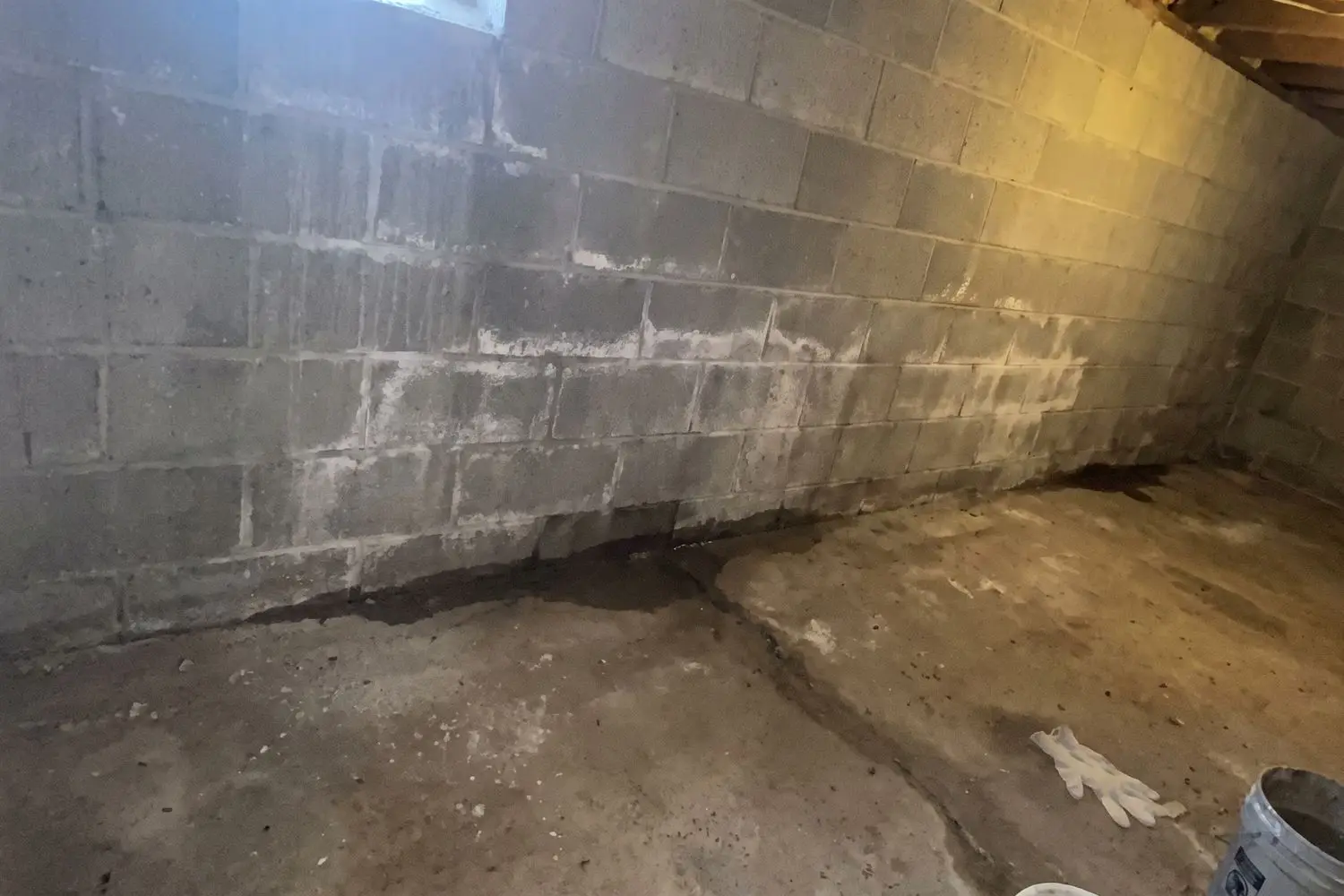
Hydrostatic pressure at the cove joint
Saturated soil pushes water in every direction, including up under the slab edge and through the seam. Where that happens in Eau Claire depends on the ground. Most of the city stands on sandy river outwash with the water table well below basement depth, so cove-joint water there usually starts at the surface: melt or roof water soaking down the loose backfill beside the wall. On the low ground along the Chippewa and Eau Claire rivers the water table sits close to the surface and rises with the river, and true groundwater seepage is common. Up on the ridges, slow-draining silt loam holds runoff against the wall instead. The fixes differ, which is why we sort out which one you have before recommending anything.
Interior drain tile and a sump: the cove joint fix
Caulk or hydraulic cement pressed into the seam does not hold back water under pressure; it moves the leak a few feet down the wall. The repair that lasts relieves the pressure: interior drain tile, perforated pipe in washed stone beside the footing and beneath the slab, carrying water to a sump basin and a sump pump that sends it outside. How the system is built, including the iron ochre that local groundwater brings, is on our basement waterproofing page. When the cove-joint water is surface water from a downspout or bad grade, fixing that outside comes first, and sometimes it is all the basement needs.
Through the wall
Leaking Basement Walls: Tie Holes, Cracks, and Block
A wall that leaks in one spot is telling you something specific about how it was built. Poured concrete leaks at its built-in weak points: the holes left by the form ties, the cracks, and the places pipes pass through. Block leaks differently, because a block wall is mostly hollow. In the photo, rust-colored streaks run down a poured wall below a long horizontal crack, the stain water leaves as it carries minerals out of the wall. A horizontal break is also a structural signal, so a crack like that gets measured, not just sealed; our basement repair guide covers how water and structural problems get sorted.
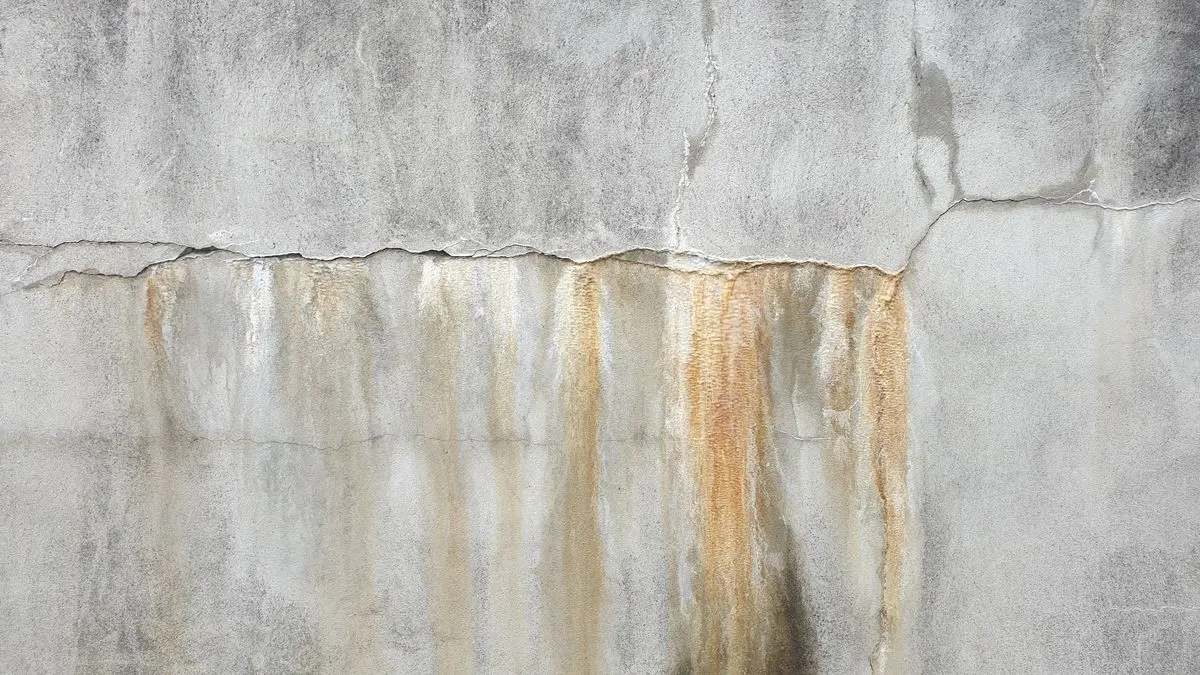
Form tie holes in poured walls
Poured walls are cast between forms held together by steel ties that run straight through the wall. When the forms come off, the tie ends are snapped off and the holes are patched. Those patches are small and sit on a wall that sees water pressure, so a leaking tie hole shows up as a wet spot or rust streak at a regular spacing, often several at the same height. The fix closes the hole from inside, injected or plugged through the wall's thickness the same way a leaking crack is. It is a small repair, and on a wall with one or two wet ties it is often the whole job.
Leaking cracks in poured walls
Vertical and diagonal shrinkage cracks are the most common leak path in poured walls. One that seeps gets polyurethane injection, which expands to fill the break and stays flexible. The material choice, and when a crack is a structural question rather than a leak, are on our foundation crack repair page. Plainly: a single leaking crack in an otherwise dry basement is an injection job, not a drain tile system, and that is what we will quote.
Block wall seepage and efflorescence
Water that soaks into block collects in the hollow cores, then weeps out through the mortar joints and the face of the lowest courses, leaving the white efflorescence and dark banding in the cove joint photo above. There is no single crack to inject. The fix drills weep holes into the cores of the bottom course so the wall drains into interior drain tile instead of onto the floor, with a dimpled membrane on the wall face guiding seepage down. Paint-on coatings fail here because the water is already inside the block pushing out; a film on the room side blisters and peels.
Openings and the floor
Water Seeping In at Window Wells, Pipes, and the Floor
Not every leak comes through solid wall. Anywhere the foundation has an opening or a joint between materials, water under pressure will find it, and each one has its own repair.
Window well leaks
A basement window sits below grade in a well, and the well collects rain, melt and roof runoff. If the gravel in the bottom has packed with silt, or there is no drain at all, water stands against the window until it finds the frame and runs down the wall below. This Old House singles out the wells around egress windows, since runoff collects there. The repair runs from simple to involved: clean or replace the gravel, add a cover that sheds rain and snow, regrade so the yard stops draining into the well, and where it is needed, give the well bottom a drain to the drainage system. A cover and a cleanout are a weekend job you can do yourself.
Pipe and utility penetrations
Water service, gas lines, conduit and sewer pipe all pass through the foundation, and the seal around each is a joint between materials that expand and move differently. When it lets go, water shows up as a wet ring around the pipe, often only when the soil outside is saturated. Penetrations rank with cracks among the most common entry points in a poured wall, and they are sealed the same way: injected from inside through the full wall, not caulked on the surface where pressure pushes the caulk back out.
Floor cracks and slab seepage
Water rising through a floor crack means there is water under the slab with nowhere to go. Sealing that crack closes one exit and the water finds the next, so the repair is drainage at the slab edge into a sump, which pulls the water down below the floor. Here this is mostly a low-ground problem: under most of Eau Claire the water table sits well below basement depth, while beside the rivers it rises close to the surface each spring. A floor that is only damp in patches, with no running water, may be condensation; the foil test below tells you which.
Not every wet basement leaks
When a Wet Basement Isn't Groundwater
Two common sources of basement water have nothing to do with the foundation, and no amount of waterproofing fixes either one. Rule them out first; it costs nothing.
Condensation on basement walls: the foil test
Basement walls and cold water pipes sit near ground temperature. When warm, humid summer air reaches them, water condenses on the surface the way it does on a cold glass, and a wall that is sweating can look like it is seeping. The test, the same one This Old House publishes: dry a patch of wall, tape a square of aluminum foil or plastic sheet tightly to it on all four edges, and leave it for 24 hours. Moisture on the room side means humidity in the air. Moisture behind it, against the concrete, means water is coming through the foundation. If it is condensation, the answer is a dehumidifier, not us; the EPA recommends keeping indoor humidity below 60 percent, ideally 30 to 50, and an inexpensive hygrometer tells you where you stand.
Plumbing leaks versus groundwater
Water that appears in dry weather, in the same spot, usually is not coming from outside. A water heater, a washing machine hose, a supply line in the joists, a condensate line: none of them follow the weather. Two quick checks. On city water, turn off every fixture and watch the meter; if the leak indicator turns, water is escaping somewhere in the plumbing. And follow the water uphill. Groundwater comes in low, at the cove joint or through the floor; plumbing water starts above or beside a fixture. Those are calls for a plumber, and we will tell you so.
Timing
When Your Basement Leaks Tells You Why
Timing is the cheapest diagnostic there is. Note when the water shows up relative to the weather, and the list of suspects gets short.
-
Within hours of a hard rain
Surface water. It only traveled a few feet: a downspout emptying at the corner, a window well filling, soil sloping back toward the wall. Look outside, directly above the wet spot, first.
-
During the spring melt
Snow sits on the ground here for more than three months in a normal winter. When it melts, the water runs over frozen ground that cannot absorb it and collects against the foundation. Cove-joint and block seepage that appears only in March and April is usually this.
-
With the river high
Groundwater. On the low ground along the Chippewa and Eau Claire rivers the water table rises with the river, and the Chippewa's biggest recent crests, in 2019 and 2023, came in the second half of April. Water that comes up days after the rain stopped, and lingers, calls for drain tile and a sump.
-
Any day, any weather
Not the weather at all. A wet spot in a dry week is plumbing; a whole wall beading on a muggy July afternoon is condensation. Neither needs waterproofing.
Keep a short log before the inspection: the date, the weather, and where the water was. Three entries of that tell us more than any single visit can.
Straight talk
Basement Leak Repair You May Not Need Us For
A good share of the leaks we look at end with a fix that costs little, and we would rather you knew that before you call. Wisconsin's dwelling code sets the standard for the ground around a house: under SPS 321.12, finished grade must slope away from the dwelling at least 1/2 inch per foot for at least 10 feet. Soil settles, beds get mulched up against the siding, and plenty of older lots no longer meet it. A wet corner after rain is very often a downspout emptying at the wall or a low spot in the bed above it. Extend the downspout, rebuild the slope, and watch the next storm. If you would rather have it done, that is yard drainage work, among the least expensive jobs we do.
Condensation gets a dehumidifier, not a drainage system. One leaking crack or a couple of leaking tie holes get injected, not a full perimeter of drain tile. A wet window well may only need its gravel cleaned out and a cover. We price the small fix as a small fix.
When a bigger repair genuinely is the answer, we show you why: water at the cove joint on more than one wall, water rising through the floor, block walls weeping along their length. Those come back every spring until the pressure is relieved. That is when interior drain tile earns its cost, or, when the wall itself needs protecting from the outside, exterior foundation waterproofing. And when the water is moving across the yard toward the house, an exterior French drain can intercept it before it reaches the wall.
Pricing
How a Basement Water Leak Repair Gets Priced
The range is wide because the repairs are. A downspout extension or a single injected tie hole sits at one end; a full perimeter of interior drain tile with a sump sits near the other, and exterior excavation runs higher still. Our basement waterproofing cost guide lays out the published national ranges for each of these fixes, with their sources, so you can see the landscape before anyone visits.
Your own number comes after the inspection: where the water enters, what is feeding it, and how many feet of wall are involved. You get one written price for the whole scope before any work starts.
FAQ
Basement Leak Repair Questions
Why does my basement only leak after heavy rain?
Because the water is coming from the surface, not the water table. Rain that reaches the basement within hours has only traveled a few feet: off the roof through a downspout that empties at the wall, down a window well with no drain, or along soil that slopes toward the house. Wisconsin's dwelling code (SPS 321.12) calls for finished grade to fall at least 1/2 inch per foot for 10 feet away from the house, and fixing the grade and downspouts above the wet spot often stops the leak without any interior work.
Can a leaking basement wall be repaired from the inside?
Usually, yes. Leaking cracks, form tie holes and pipe penetrations in poured walls are injected from the inside through the full thickness of the wall. Block walls are drained from the inside, with weep holes into interior drain tile and a sump. Exterior excavation and membrane work is the answer when the wall itself needs protection from outside and the yard allows digging, and in Wisconsin that waits for thawed ground. A coat of waterproof paint on the inside face is not a repair for an active leak; our guide to sealing basement walls explains what coatings can and cannot do.
How do I tell condensation from a basement leak?
Dry a patch of the wall, tape a square of aluminum foil or plastic sheet tightly over it on all four edges, and leave it for 24 hours. Moisture on the room side means humidity in the air is condensing on a cool wall. Moisture behind it, against the concrete, means water is coming through the foundation. Condensation is solved with a dehumidifier, not waterproofing; the EPA recommends keeping indoor humidity below 60 percent, ideally 30 to 50 percent.
Will sealing a floor crack stop water coming up through the floor?
Not for long. Water rising through a floor crack is under pressure beneath the slab, and sealing one crack sends it to the next crack or the cove joint. The lasting repair lowers the water under the floor with drain tile along the slab edge feeding a sump. A dry hairline crack in a basement floor, on the other hand, is usually concrete shrinkage and needs nothing.
Can basement leaks be repaired in winter?
Interior repairs can. Injection, drain tile and sump work all happen inside the basement and proceed in any month, and winter is a sensible time for them, because the spring melt is when most Eau Claire basements leak. Exterior digging and regrading wait for the ground to thaw.
Free inspection
Get the Leak Traced
Tell us where you see the water and when it shows up. We will find the entry point, tell you what is feeding it, and put the right repair in writing, including when the right repair is a downspout extension or a dehumidifier.