Crack injection & repair
Foundation Crack Repair in Eau Claire
Foundation Crack Repair is the craft of closing a break: reading what caused it, choosing the right injection material, and fixing the water pressure that opened it in the first place. Done properly, the repair restores the wall and shuts off the leak in a single visit, with materials that meet the ASTM C-881 standard for structural epoxy. Eau Claire Drainage & Waterproofing inspects first, explains what the wall is telling us, and puts the price in writing.
- Licensed & Insured
- Free Inspections
- Locally Owned
- Year-Round Service
The problem
Why Foundation Cracks Deserve Attention
The national numbers say cracks and the water behind them are ordinary, not rare. Census housing-survey data compiled by Lawrence Berkeley National Laboratory found 9.9 percent of US homes with water damage from exterior leakage, and across peer-reviewed surveys roughly 23 percent of houses report basement water. Concrete guidance is just as specific: ACI 224R treats about 0.012 inches as the tolerable crack width for concrete exposed to moist air or soil, which is thinner than most homeowners ever notice.
Eau Claire adds its own pressure. Most of the city stands on fast-draining sandy outwash, so what loads a foundation wall from outside is usually roof runoff and snowmelt collecting in the backfill against it. The uplands shed runoff toward the houses below, and a winter that leaves snow on the ground for more than three months drives frost deep. Water inside a crack expands roughly 9 percent when it freezes, and federal highway research shows concrete microcracking accumulates with each freeze-thaw cycle. A hairline in October is rarely still a hairline in April.
That is the real case for repairing them early: not panic, but arithmetic. A crack is the cheapest thing you will ever fix on a foundation. The versions that come later, wider gaps, wet floors, bowed block, cost more every season you wait.
Diagnosis first
Reading the Crack Before Repairing It
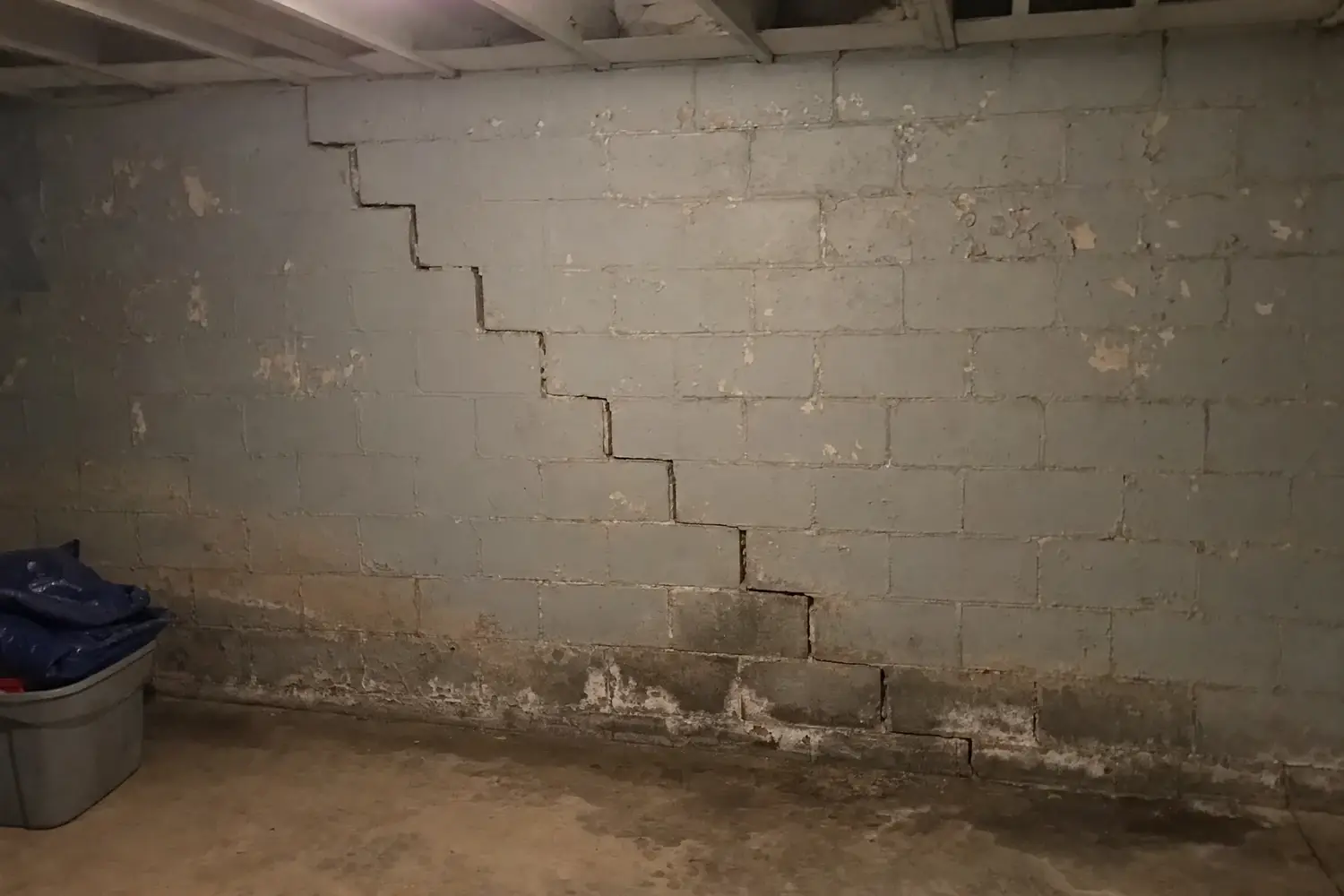
Cracks are information. From a hairline to a wet horizontal break, direction, width, and behavior tell us what the foundation is doing and which repair fits. In the block wall pictured, a stair-step crack follows the mortar joints down to the floor, and the lowest courses are water-stained and marked with white efflorescence. A stair-step pattern in block usually means the wall has moved, from settlement or soil pressure, rather than just shrinking as it cured. On block, the fix points to the cause rather than to injection: drainage and pressure relief when soil is pushing on the wall, structural support when it has settled. A crack with open, offset joints like this one gets measured during the inspection, including whether it needs an engineer.
Shrinkage cracks in poured walls
Most poured walls crack a little as they cure. Concrete shrinks as moisture leaves its pores, and when the slab or soil restrains that shrinkage, tensile stress opens the wall, typically within weeks of construction. Industry specifications allow about 0.05 percent drying shrinkage, roughly six-tenths of an inch across 100 feet. These are usually vertical or diagonal, narrow, and stable. They still need sealing, because they are a path for water, but they are rarely a structural alarm.
Horizontal cracks and soil pressure
A horizontal crack is a different conversation. Home-inspection guidance is blunt about it: saturated soil pushing on the outside of the wall bends it inward, and the break that forms is usually horizontal, wider than hairline, and wet. That pattern is a symptom of hydrostatic pressure, so the repair has to include relieving the pressure, which is where our foundation waterproofing and drainage work comes in alongside the injection.
Stone and block: the joints are the weak point
A large share of older Eau Claire foundations, about one in six homes here predates 1940, are rubble stone or early block. Those walls often weep through dozens of mortar joints at once, and when block does crack in one line, it follows the joints in a stair-step like the wall pictured above. Injection is the wrong tool for either pattern. Failed joints get repointed with mortar matched to the original hardness, and the water gets managed at the floor line with interior drainage.
Cracks that are still moving
Width today matters less than direction. A crack that grows season over season, or one paired with a wall that is measurably out of plumb, means the cause is still active. Injecting a moving break with a rigid material just moves the break next door. Those get a flexible repair and a drainage plan, and genuinely structural movement gets named honestly during the inspection, including when it needs an engineer.
The right material
Epoxy Injection or Polyurethane Injection
Crack injection succeeds or fails on material selection, and the manufacturers publish the rules. Structural injection epoxy cures rigid and strong: a standard product data sheet lists concrete-to-concrete bond strength around 1,300 psi within two days and compressive strength near 13,000 psi, several times stronger than the wall itself. That is the tool for dry, stable cracks where the goal is to rebond the concrete into one piece again.
The same data sheets list the limitation that matters in a wet basement: structural epoxy is not for cracks under hydrostatic pressure or on wet surfaces. A leaking crack gets injection polyurethane instead. It is water-activated, expands up to 30 times its liquid volume to fill the full depth of the break, stays flexible at around 44 percent elongation, and is rated to stop water even against high-pressure flow. Flexible, expanding, and waterproof is exactly what an active leak calls for.
Eau Claire Drainage & Waterproofing works with both because local basements need both, sometimes on the same wall. The inspection determines which material goes where, and the aim is to fill the break through the full thickness of the wall.
The bigger picture
When Crack Repair Alone Is Not the Fix
An injected break is sealed, but the water that found it is still out there, and water that loses one path looks for the next. When the opening was carrying real groundwater, the full repair pairs the injection with drainage: interior drain tile and a sump through our basement waterproofing systems when the water table is the source, or exterior grading and downspout work when the surface is feeding the wall.
That pairing is also what protects the repair itself. Take the pressure off the wall and a sealed break has less working against it; leave the pressure in place and this winter's freeze-thaw cycles start prying at the next weak point. We will tell you plainly which situation you have, because injecting a wall that needed a drainage fix is how a homeowner ends up paying twice.
Beyond the crack
Other Places a Foundation Lets Water In
Floor cracks and water through the slab
Concrete shrinks as it cures, so hairline cracks can open across a basement floor, and shrinkage cracks tend to be shallow and stable. Water rising through one is a different signal. It means there is water under the slab, under pressure. Sealing the crack closes that path but leaves the water where it is, so the usual answer is drainage under the slab edge that carries it to a sump. Location matters too: under most of the city, groundwater sits well below basement depth, while on the low ground along the Chippewa and Eau Claire rivers it is close to the surface and moves up and down with the river.
Pipe penetrations, tie rod holes, honeycombing and cold joints
A poured wall has built-in weak points besides cracks: pipe penetrations, tie rod holes, honeycombing and cold joints. Pipe penetrations, where a pipe passes through the wall, rank with cracks as the most common entry points in poured walls, and like cracks they can be injected. InterNACHI's guide to inspecting concrete traces honeycombing to concrete that was not fully consolidated during the pour, and a cold joint to fresh concrete placed against concrete that had already hardened. FEMA lists hydraulic cement among the ways to close foundation cracks, while injection pressure-fills the opening from the inside. Which one fits depends on the flaw and on whether water is pushing through it.
Bowing or leaning walls
A wall that bows or leans inward is showing soil pressure, which is a structural matter rather than a leak. InterNACHI ties horizontal cracking to lateral pressure from water-saturated soil, and its guidance is that a structural engineer should design the correction. Saturated soil raises both the water pressure behind a leak and the load that bends a wall. To be plain: the service on this page, like the rest of our Eau Claire waterproofing and drainage work, is crack injection and drainage, not bracing or straightening a wall that has moved. For sellers, the Wisconsin Real Estate Condition Report (Wis. Stat. 709.03) asks whether the owner is aware of defects in the basement or foundation, and it names cracks, seepage and bulges.
Cost
What Foundation Crack Repair Costs
National cost guides put professional crack injection in a fairly tight band: This Old House lists professional epoxy injection at $800 to $1,500 per crack, while Fixr publishes a lower $250 to $1,000 range for the same work. Those are national figures from the guides themselves, not our prices, but they frame the honest point: a single-crack repair is one of the least expensive foundation jobs there is.
What moves a real number is what the wall turns out to need. One stable shrinkage line is the low end. Several at once, a leaker that needs polyurethane and a drainage correction, or a stone wall that needs repointing each price differently. We inspect first, explain what we found, and give you one written number before any work starts. If it is a simple one, you will hear exactly that.
FAQ
Foundation Crack Repair Questions
How do I know if a foundation crack is serious?
A foundation crack is serious when it is horizontal, wider than about 1/8 inch, growing, or letting water through. Concrete industry guidance (ACI 224R) treats tolerable crack widths in damp or soil-exposed concrete as roughly 0.012 inches, about the thickness of three sheets of paper, and home-inspection guidance flags horizontal cracks as a sign of soil pressure bending the wall inward. Vertical hairline shrinkage cracks are common and usually stable. The honest answer for any specific wall comes from looking at it, which is what our free inspection is for.
Should a leaking crack get epoxy or polyurethane?
A leaking crack almost always gets polyurethane, not epoxy. Manufacturer data sheets are explicit: structural injection epoxy is not for cracks under active water pressure or wet surfaces, while injection polyurethane is water-activated, expands up to 30 times its volume, and is designed to stop water infiltration even against flowing water. Epoxy earns its place on dry, stable cracks where the goal is structural rebonding, since a cured structural epoxy bonds at around 1,300 psi, stronger than the concrete around it.
Can foundation cracks be repaired in winter in Eau Claire?
Yes. Crack injection is interior work on the inside face of the wall, so it proceeds in any month, and winter is actually a sensible time because Wisconsin freeze-thaw cycles are actively working on open cracks. Water in a crack expands about 9 percent when it freezes, wedging it wider with every cycle. Sealing before the spring melt means the wall meets the wettest season already closed.
Free inspection
Get Your Crack Looked At
Send a photo if you like, but the real answers come from the wall itself. We will read it, check the water behind it, and hand you a written price for the right repair. Free, no pressure, and honest about which cracks are nothing to worry about.