Basement Waterproofing
Basement Waterproofing in Eau Claire, WI
A wet basement is one of the most common problems Eau Claire homeowners face, and one of the most fixable. Whether you've got water seeping in after every heavy rain, a musty smell that won't quit, white residue creeping up the walls, or inches of water on the floor after the spring melt, Eau Claire Drainage & Waterproofing finds where it's getting in and stops it. Our licensed and insured crew waterproofs basements from the inside and the outside, and every job starts with a free, no-pressure inspection.
- Licensed & Insured
- Free Inspections
- Locally Owned
- Year-Round Service
Warning signs
Signs Your Basement Needs Waterproofing
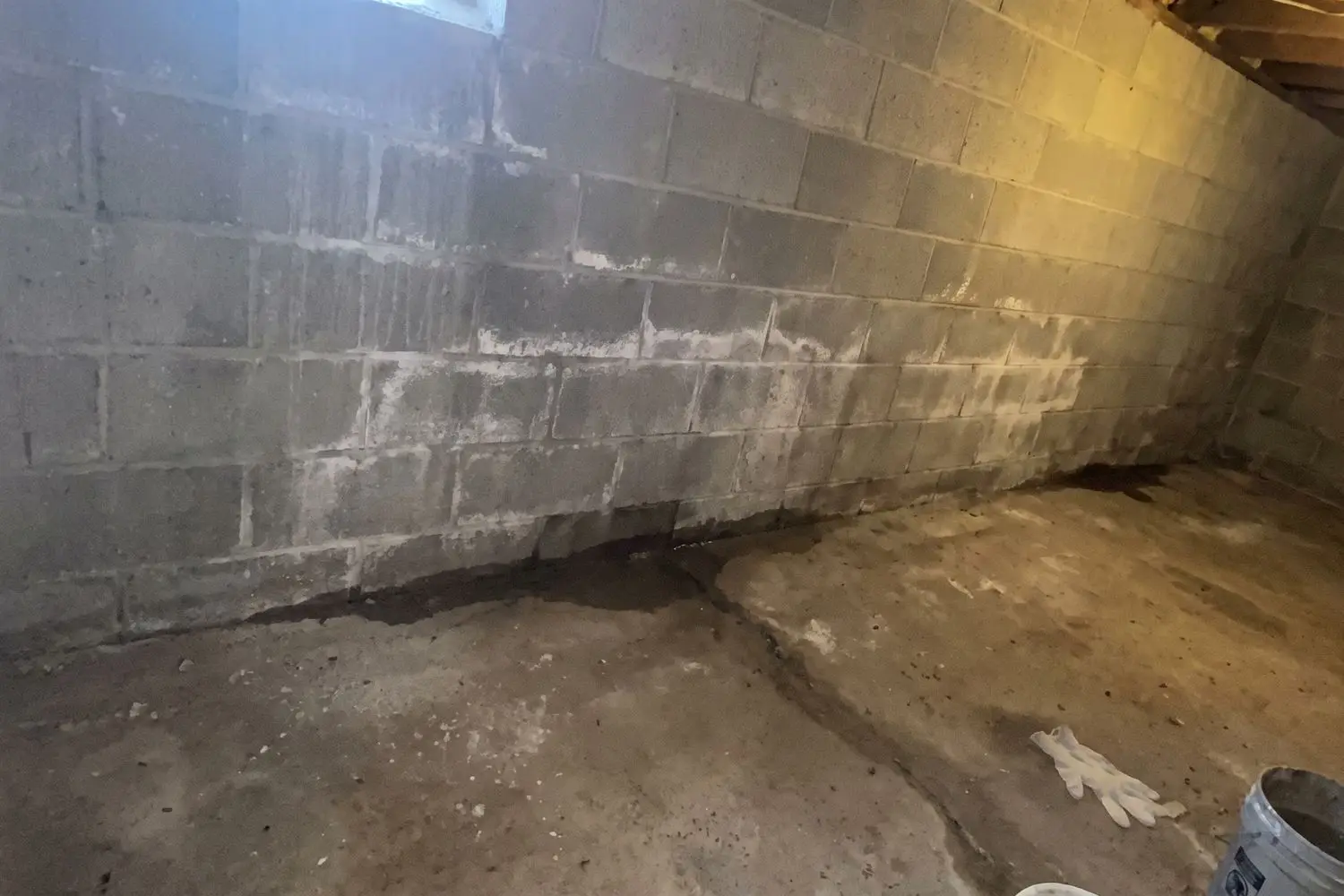
Basement water problems usually announce themselves long before there's standing water, and the earlier you catch them, the cheaper they are to fix. The block wall pictured here is a textbook example: dark banding where the lower courses stay damp, white efflorescence blooming where moisture wicks through the block and evaporates, and a wet seam along the cove joint at the base of the wall. Watch for:
- Water or damp spots on the floor or walls after rain or snowmelt
- A musty, earthy smell that lingers no matter how much you clean
- Efflorescence: the white, chalky residue left when water moves through concrete or block
- Water stains, discoloration, or a high-water "tide line" on the walls
- Cracks in the foundation walls or floor, especially ones that weep water
- Peeling paint, bubbling, or flaking on basement walls
- High humidity, condensation, or a basement that always feels damp
- Mold or mildew on walls, framing, or stored items
- A sump pump that runs constantly, or doesn't run when it should
If any of these sound familiar, water has already found a way in. The question isn't whether to address it, but how. That depends on where it's coming from.
The causes
What Causes a Wet Basement in Eau Claire
Water gets into a basement because something is pushing it there and something is letting it through. In the Chippewa Valley, a few local factors make basements especially prone to it.
Hydrostatic pressure and a shallow water table
When the ground around your foundation is saturated, it creates hydrostatic pressure, the constant force of standing water pressing against your basement walls and floor. Eau Claire's valley floor makes that pressure unusual. The city sits on sandy river outwash, not clay, so rain and melt soak straight down into a water table that already runs shallow, and the push comes up under the floor slab and against the lower courses of the wall. Up on the ridges, slow-draining silt loam does the opposite and holds runoff against the wall from above. Either way, the pressure drives water through any weakness it can find.
Spring snowmelt and the water table
Our worst season for wet basements is spring. A winter's worth of snow melts over still-frozen ground that can't absorb it, the water table rises, and the soil around your home fills with water that has to go somewhere. Midwinter thaws do the same on a smaller scale. It's why basement waterproofing here isn't a summer-only concern.
The cove joint, cracks, and porous walls
Water takes the path of least resistance. The most common entry points we find are the cove joint, the seam where the wall meets the floor slab, along with foundation cracks (even hairline ones) and the natural porosity of concrete and block, which can wick water straight through the material. Window wells that don't drain are another frequent culprit.
Surface water and grading
Sometimes it starts above ground. Downspouts that dump roof runoff at the foundation, or soil graded toward the house instead of away from it, deliver water right where you don't want it. These are often the simplest and cheapest issues to correct, which is why we check them first.
Our solutions
How We Waterproof Your Basement
There's no single fix that works for every basement. Once we pinpoint where the water is coming from, we recommend the solution, or combination, that addresses your home's actual problem instead of covering the symptom.
Interior drainage systems (drain tile + sump)
For many Eau Claire basements, the most reliable fix is an interior drainage system. We install interior drain tile (perforated pipe set in gravel around the inside perimeter at the footing) that collects water as it enters and channels it to a sump basin, where a sump pump moves it safely away from the home. Because this work happens inside, we can install it year-round, even in the middle of a Wisconsin winter. It's an especially effective answer to cove-joint leaks and a high water table.
Crack repair and sealing
Where water is coming through specific cracks, we seal and repair them directly, often with polyurethane or epoxy injection that fills the crack through the full thickness of the wall. This closes the entry point and helps protect the structure from further intrusion.
Exterior waterproofing
When the situation calls for it, the most thorough protection comes from outside. Exterior waterproofing means excavating around the foundation, cleaning and sealing the wall with a waterproof membrane, and installing or restoring a footing drain to carry water away before it can build pressure against the wall. Because it requires excavation, this is seasonal work in our climate.
Sump pumps and battery backups
A sump pump is the engine of any interior system: it removes the water your drainage collects. We install dependable pumps, replace failing ones, and add battery backups so a power outage during a spring storm doesn't leave your basement unprotected.
Vapor barriers and wall systems
To control humidity and condensation, a vapor barrier or wall membrane keeps moisture from passing through the walls into the living space, which is useful for finished or soon-to-be-finished basements.
The system, in detail
Interior Drain Tile Systems: What Goes In and Why
Interior drain tile is the workhorse of basement waterproofing in Eau Claire, so it is worth knowing what a properly built system looks like before anyone quotes you one.
Where the pipe sits
The pipe belongs inside the footing, beneath the slab. University of Minnesota Extension rates a perforated drain pipe installed inside the perimeter of the footing as the most effective interior drainage approach, because it drains the ground to a lower level than a channel glued to the top of the floor ever can. Getting there means cutting out a strip of slab along the wall, usually 12 to 18 inches wide, trenching beside the footing, and looping the pipe to a sump basin. Wisconsin's new-construction standard, SPS 321.17, puts the top of the pipe at or below the top of the footing and grades it at least 1/8 inch per foot toward the sump. A good retrofit follows the same logic.
Stone, pipe, and filter
Three parts do the work. A 4-inch perforated pipe, laid perforations down. Washed stone around it, 1/2 to 3/4 inch, with at least 2 inches under the pipe and 6 inches over it, the spec the U.S. Department of Energy's Building America guide gives for footing drains. And a filter between soil and stone, either landscape fabric or a sock on the pipe, so the fine sand this valley is built on cannot migrate into the system and silt it shut. Skip the filter on Plainfield sand and the drain slowly fills itself in from the outside.
Iron ochre, the local complication
Wisconsin groundwater carries iron. The DNR lists it among the most commonly detected natural contaminants in the state, roughly 30 percent of Wisconsin wells exceed the 0.3 milligram-per-liter iron guideline, and Eau Claire County's 2018 groundwater report flags public systems above that level. When iron-rich water meets air inside a drain pipe, bacteria turn it into a rust-colored slime called iron ochre that clogs perforations, pumps, and discharge lines. Michigan State University Extension puts the highest ochre risk in fine and silty sand with a high water table, which describes the Eau Claire valley floor. The answers get built in from the start: cleanout access for jet flushing, a knitted-sock pipe instead of narrow slots, and a float setting that keeps the pipe and pump submerged so the bacteria are starved of the oxygen they need.
Frost, footings, and where the water goes
The system ends at a sump pump and a discharge line, and both live under Eau Claire rules. State code sets footings at least 48 inches below grade for frost, so the tile beside them sits at or below the frost depth the code is written around. City code keeps sump water out of the sanitary sewer and off the building's sewer line entirely, so discharge goes to grade or storm drainage, far enough from the house that it does not cycle straight back into the sump, and placed where it will not glaze a sidewalk in January.
Older homes
Waterproofing Stone, Rubble, and Early Block Foundations
About one in six Eau Claire homes was built before 1940: 5,543 of the city's 31,712 housing units by the latest Census estimate. In the Third Ward and around Randall Park, both placed on the National Register of Historic Places in 1983 after the city's own 1982 survey, that often means a fieldstone or rubble foundation, or early block, laid in lime-based mortar. The National Park Service notes that portland cement was not in common use in this country until the early 1900s, so these walls are held together by something softer than anything mixed today. They do not leak through one crack. They weep through dozens of joints at once, often along the lowest courses where the water table sits.
That changes the fix. Injection products are built for a single defined crack: Sika's data sheet for its crack-repair epoxy caps the crack width at 1/4 inch and rules out cracks under hydrostatic pressure during application, and a rubble wall offers neither a single crack nor a dry one. So the water gets managed where it arrives instead. Interior drain tile inside the footing collects what comes through the wall base and the floor, and a drainage membrane or vapor barrier on the wall sends the weeping joints down into the tile rather than out onto the floor. Digging out alongside a lime-mortar wall removes the soil that has braced it for a century, which is why we treat exterior excavation on rubble as a last resort, not a first move.
Where the joints themselves need attention, the rule in the National Park Service's Preservation Brief 2 governs: repointing mortar must be softer and more vapor-permeable than the stone and no harder than the original mortar, because a mortar stronger than the masonry "will not give" and relieves stress by cracking the stone instead. In practice that means a Type O or Type N mix under the ASTM C270 standard, roughly 350 to 750 psi, rather than the 1,800 psi Type S sold for new block. Repointing is part of our foundation crack repair work, and on an old wall it comes after the drainage, never instead of it.
Which do you need?
Interior vs. Exterior Waterproofing: Which Do You Need?
It's the question we hear most, and the honest answer is that it depends on where the water is coming from. Interior waterproofing (drain tile, a sump system, crack repair, vapor barriers) manages water that's already reaching the basement, capturing it and routing it out. It's less invasive, more affordable, and can be done year-round, which makes it the right call for the majority of homes. Exterior waterproofing (excavation, membrane, footing drains) stops water before it reaches the wall and offers the most complete protection, but it's a bigger, seasonal job. Many basements are best served by a combination: managing surface water and grading outside while controlling intrusion inside. We'll tell you straight which your home actually needs after we inspect it, not which one is most expensive.
Cost
How Much Does Basement Waterproofing Cost in Eau Claire?
There's no honest flat answer, because the cost depends entirely on what's causing the problem and what it takes to fix it. Correcting a downspout and regrading a section of yard is a modest job. A full interior drainage system with a new sump pump is a larger investment. Exterior excavation and membrane work sits higher still. The size of your basement, the severity and source of the water, and the solution required all factor in. That's exactly why we inspect first and give you a clear, upfront price before any work begins (our basement waterproofing cost guide walks through the published national ranges), so you know precisely what you're paying for, with no surprises. If your problem turns out to be a simple one, we'll tell you that, too.
What to expect
What to Expect
-
Free inspection.
We come to your home, examine the basement, foundation, and the grading and drainage around it, and identify exactly where the water is getting in and why.
-
Clear diagnosis and quote.
You get a straightforward explanation of the problem and the solution we recommend, with an upfront price.
-
Professional installation.
Our licensed and insured crew completes the work and cleans up the site.
-
A dry basement.
The water goes where it should, and your basement stays usable and protected.
Why us
Why Eau Claire Homeowners Trust Us With Their Basements
We're locally owned, and we work throughout Eau Claire and the Chippewa Valley, so we know the soil, the seasons, and the water problems specific to this part of Wisconsin. We're licensed and insured, we offer free and honest inspections, and because we do both interior and exterior work, our recommendation is based on what your basement actually needs, not on the one service we happen to sell. And since interior waterproofing doesn't stop for winter, neither do we.
FAQ
Basement Waterproofing FAQs
How do I know if I need basement waterproofing?
If you're seeing water or dampness after rain or snowmelt, a musty smell, efflorescence (white residue) on the walls, water stains, or cracks that weep, water is getting in and your basement would benefit from waterproofing. A free inspection is the surest way to know the cause and the right fix.
Can you waterproof a basement from the inside?
Yes. Interior waterproofing is the most common solution we install. An interior drainage system (drain tile plus a sump pump), crack repair, and vapor barriers all work from inside the basement, are less invasive than exterior excavation, and can be installed year-round.
Is drain tile the same as a French drain?
Drain tile and a French drain are the same idea in two different places: perforated pipe bedded in washed stone that collects groundwater and carries it away by gravity. In Eau Claire the words usually split by location. Drain tile, also called a perimeter drain or weeping tile, runs inside the basement along the footing, beneath the slab, and empties into a sump basin. A typical basement here has 120 to 150 feet of perimeter to drain, and because the work is indoors it can go in any month of the year. A French drain runs outside, through the yard or along the foundation, and daylights downhill or feeds a dry well. Most wet basements here need the interior version, sized for a shallow water table that rises with every spring melt. See how we build exterior French drains.
What's the best way to waterproof a basement?
There isn't one universal "best" method. The right approach depends on where the water is coming from. Interior drainage handles a high water table and cove-joint leaks; crack injection handles water coming through specific cracks; exterior membrane and footing drains offer the most complete protection where excavation makes sense. The most lasting results come from matching the solution to the actual source, which is what our inspection determines.
How much does basement waterproofing cost in Eau Claire?
It depends on the cause and the solution. A grading and downspout fix is very different from a full interior drainage system or exterior excavation. We inspect first and give you an upfront price before any work starts, so there are no surprises. Our cost guide walks through the published national ranges.
Will basement waterproofing get rid of the musty smell?
Usually, yes. That musty smell typically comes from moisture, mold, and mildew. Once the water source is controlled and the basement dries out, the smell generally goes with it, and controlling humidity with a vapor barrier helps as well.
Can you waterproof my basement in the winter?
Yes. Interior solutions (drain tile, sump pumps, crack repair) can be installed year-round, even in deep winter. Only exterior excavation work is seasonal in our climate. Winter and early spring are actually when many basement water problems first appear.
Do you install sump pumps too?
Yes. We handle new installations, replacements, repairs, and battery backups. A sump pump is what removes the water an interior drainage system collects, so a reliable, backed-up pump is essential.
Free inspection
Get a Free Basement Waterproofing Inspection
If there's water in your basement, don't wait for it to get worse or more expensive. Call Eau Claire Drainage & Waterproofing or request a free inspection, and we'll find exactly where the water is coming from and how to stop it.